Showing posts with label southern religion. Show all posts

Saturday, April 10, 2010

Rival Revivals and Liberal Protestant Recovery

Rival Revivals and Liberal Protestant Recovery
Paul Harvey

Just back from the Organization of American Historians (OAH), I had planned on doing an extensive post on the excellent panel I saw there, “Rival Revivals,” featuring papers by Alison Greene, Jarod Roll, and Matt Sutton, and with commentary by Kenneth Fones-Wolf and chaired by Lizabeth Cohen. But now I don’t have to, as we have an excellent summary of the panel from the OAH reporting at HNN, with full videos of the presentations and summaries of the papers. I would just say in addition to what is there that the panel featured the interesting twist of having the fundamentalists of the 1930s/1940s (discussed in Matt’s paper) as the northern, educated elites, in comparison to the various folk preachers, Garveyites, and premillennial radicals discussed in Alison and Jarod’s papers, turning the usual stereotypes about recent fundamentalism on its head.

Cover for ROLL: Spirit of Rebellion: Labor and Religion in the New Cotton South. Click for larger image

The material in Jarod Roll’s paper came from his book, out any day now (I saw it at the University of Illinois press table at the OAH, but wasn’t between regular hard covers yet), entitled Spirit of Rebellion: Labor and Religion in the Cotton South. A bit more about the work here:

In Spirit of Rebellion, Jarod Roll documents an alternative tradition of American protest by linking working-class political movements to grassroots religious revivals. He reveals how ordinary rural citizens in the South used available resources and their shared faith to defend their agrarian livelihoods amid the political and economic upheaval of the first half of the twentieth century.

On the frontier of the New Cotton South in Missouri’s Bootheel, the relationships between black and white farmers were complicated by racial tensions and bitter competition. Despite these divisions, workers found common ground as dissidents fighting for economic security, decent housing, and basic health, ultimately drawing on the democratic potential of evangelical religion to wage working-class revolts against commodity agriculture and the political forces that buoyed it. Roll convincingly shows how the moral clarity and spiritual vigor these working people found in Pentecostal revivals gave them the courage and fortitude to develop an expansive agenda of workers’ rights by tapping into existing organizations such as the Socialist Party, the Universal Negro Improvement Association, the NAACP, and the interracial Southern Tenant Farmers’ Union.

Yesterday morning I attended an equally excellent panel of a very different sort: “Putting Faith in American Democracy: Remembering Liberal Protestantism in the Twentieth Century,” featuring papers by Mark Edwards, Matthew Hedstrom, and Bryan Peery, and with commentary by Mark Hulsether. Mark discussed Protestant ecumenicism in the post WWII era, emphasizing how it dovetailed with a one-world liberalism rather than a Cold War realism that we associate with Reinhold Niebuhr. Matt’s paper discussed the Protestant liberal influence on the American Library Association, which created a sort of quasi-canon of books to read each year (sort of a well-publicized “top 50” list), one which pushed a reading public towards Protestant liberal thought and thus exerted more influence culturally than we might recognize looking only at the Protestant liberals and politics. Bryan Peery, a graduate student at George Washington, covered the course of Protestant-Catholic dialogue after WW II and the vital influence of Robert McAfee Brown in the same, who held that “dialogue itself was valuable, even if it only led to more dialogue.” Those views competed with an upsurge of anti-Catholicism signaled in Paul Blanshard’s 1949 screed American Freedom and Catholic Power, which compared the Vatican to the Kremlin.

Hulsether called for more appreciation and respect for mid-century liberal Protestants. Often they are interpreted as being powerless -- thus, nowhere -- or as leading the charge for a “secular neutrality” that was just liberal Protestantism in disguise -- and hence, everywhere. He suggested that the Protestant liberals assumed a position sort of like the UN non-aligned movement in distinction to the choosing up of sides going on in the Cold War, and that their vision should be given more respect and credence than is usual in a scholarship which in recent years has made the Protestant liberals the object of target practice.

Politically radical premillennialists, preachers jumping out of airplanes to call attention to the imminent millennium, Garveyite devotees picking up the cause of radicalism in the South, Protestant liberals demanding alternative visions besides those given to them during the Cold War, northern fundamentalists wondering if the “Blue Eagle” of the NRA was the mark of the best -- who said 20th century Protestants were boring?

Friday, February 26, 2010

What about Southern Irreligion?

Art Remillard

As one brilliant (and humble) reviewer summarized, volume one of The New Encyclopedia of Southern Culture "is comprehensive, relevant, and representative of past and present trends in the field of southern religion." If there is something missing here, chances are Sam Hill's hulking Encyclopedia of Religion in the South would have it.

Yet this morning, while flipping through the entries and indexes of both, I couldn't find a single reference to southern irreligion. No atheism, agnosticism, freethinking, or skepticism. And why would I? As Randall "Emotive Cutting Language" Stephens rightly said, the South is "the prayer capitol of America." But academic historians are in the business of finding new and unexplored topics (and convincing us of how important these topics are). So isn't there someone willing to fill this gap? Well, we might just have somewhere to begin with John Sparks's Kentucky's Most Hated Man: Charles Chilton Moore & The Bluegrass Blade. From the book description:

...born in 1837, [Charles Chilton Moore] was the grandson of religious reformer Barton W. Stone, and was himself a minister in Versailles, Kentucky, before he left the church, passing through deism and agnosticism to eventually declare himself an atheist. Moore founded The Blue Grass Blade newspaper in 1884 in Lexington. He was only able to publish sporadically due to financial and legal problems originating mostly because of the paper's editorial content--attacks on citizens that Moore considered to be bigots (including Bible-thumpers and whiskey distillers) and his advocacy of unpopular positions such as agnosticism and women's suffrage. . . . Moore is considered one of the fathers of American atheism. The Blue Grass Blade was circulated across the country, gaining him notoriety among both the religious and non-religious. . . . His legal trials resulted in landmark Federal judicial decisions which set precedents in the areas of both freedom of religion and
freedom of the press.

Stylistically, the book is similar to Sparks's biography on "Raccoon" John Smith (subtitled, Frontier Kentucky's Most Famous Preacher--I'm seeing a pattern here). In his review, Craig Thompson Friend lamented Sparks's penchant for prolonged digressions, reliance on outdated sources, and lack of attention to the historiography. The same can be said of Kentucky's Most Hated Man. But Sparks is not an academic historian. And he seems rather unconcerned with our insights and criticisms. Still, the book might be conversation starter. Citing Susan Jacoby's Freethinkers, Sparks observes that Moore came along during the "Golden Age of Freethought," and modeled himself after "The Great Agnostic," Robert Green Ingersoll.

So Moore localized a national freethinking trend in Dixie. He also felt the Bible Belt's wrath as a result. The debates that Moore generated found southern evangelicals articulating their beliefs in new ways, fending off the unique challenges put forth by this atheist interlocutor. How many Moores were there in the New South? Who knows. But somewhere, there's an ambitious doctoral student searching for a topic--hopefully that person will be willing to write an encyclopedia entry or two.

Saturday, February 13, 2010

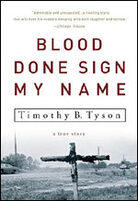
Blood Done Sign My Name -- Out in Film!


Paul Harvey

Congratulations to Tim Tyson, whose gripping memoir/history book Blood Done Signed My Name, has found its way onto the big screen. This New York Times story covers this particular tale of book to film, and discusses the way both author and filmmakers sought to avoid the comforting but tired narratives of civil rights victory where whites somehow manage to play the leading role.

Dr. Tyson, who was 11 in 1970, chronicles the struggles that his father, Vernon, a Methodist minister, faced in advocating civil rights progress to a conservative parish. (Vernon Tyson was effectively driven out of Oxford by the end of 1970.) Mr. Stuart’s father was a Presbyterian minister who faced similar trials in Gastonia, N.C.
When Mr. Steel and Mr. Stuart met with Dr. Tyson to discuss turning “Blood Done Sign My Name” into a movie, with Mr. Stuart as writer and director, the author was initially leery of turning over his work to a Hollywood filmmaker bearing the name of a Confederate general. (Mr. Stuart was nicknamed for, but not descended from, the rebel cavalry officer J. E. B. Stuart.) But the men soon discovered they agreed on what the movie should avoid.
“One of the goals was not to make ‘To Kill a Mockingbird,’ ” Mr. Stuart said in an interview at Mr. Steel’s Greenwich office. “What always happens in the way Hollywood tells these stories is that the white guy saves the day. I did not want to fall into that trap. The Tysons got run out of town. Tim’s dad is one of my heroes in this movie, but he’s not Gregory Peck. He’s not going to make it all right for everybody.”

Besides being a fan of “The Fugitive” Dr. Tyson was happy to learn that he and Mr. Stuart both loathe movies like “Mississippi Burning” and “Ghosts of Mississippi,” in which conflicts between good and bad white people overshadow the actions of blacks. Interviewed by phone from his current home in Durham, where he teaches African-American studies at Duke University, Dr. Tyson said that Hollywood’s distortions have helped reinforce the gauzy mythology of the struggles of the Rev. Dr. Martin Luther Kingand others.

“We have this sugarcoated confection of the civil rights movement in popular memory,” he said. “It’s interracial, it’s nonviolent, and it’s successful. Nobody ever opposed it. In this rendition the civil rights movement is largely a call to America’s conscience that America pretty much answered.” The reality, he said, was more complex.

A trailer for the film is here, and Tim talks about the book here.

Saturday, February 6, 2010

Black Threads


Paul Harvey

The history of African American quilting has received much attention lately, and religious historians should take notice, for it’s way past time to incorporate material artifacts and art into our work more than we customarily do. I've recently been going through a veritable museum of southern religious folk art, astounding in its variety and imagination, sometimes for its sheer weirdness, other times for its heartfelt piety.

Unfortunately, some of the history of African American quilting has been subject to mythologizing and a good deal of assertion without much in the way of evidence (quilts as maps for the underground railroad, that sort of thing). This kind of myth-making, together with the normal obstacles confronting those seeking out solid information on nineteenth-century African American women, makes solid work in pre twentieth-century African American folk art a challenge -- see for example the controversy about the sankofa symbol at the African Burial Grounds in New York, whose African provenance recently has been called into question by scholar Erik Seeman (his article about this has just been published in the William and Mary Quarterly).

Recently author Kyra E. Hicks was kind enough to alert me to her new book This I Accomplish: Harriet Powers’ Bible Quilt and Other Pieces, and it was a fascinating text to peruse. Hicks maintains her own blog Black Threads here, and her relentless researching on her quest to uncover all the information she can about the famous quilter and folk artist Harriet Powers (whose work is displayed at the Smithsonian and the Boston Museum of Fine Arts) would put many historians to shame. This I Accomplish mines numerous sources and presents an extensive bibliography for all those interested not only in Powers, but in the relationship of African American Christianity and folk arts such as quilts.

Here’s a description of Hicks’s work which summarizes the contents, and I hope will attract some attention to the work of this energetic researcher:

The powerful quilts of Harriet Powers (1837-1910), a former Athens, Georgia slave, continue to capture our imagination today. Her two-known creations, the Bible Quilt and the Pictorial Quilt, have independently survived since stitched more than a century ago. Over the years, thousands of museum visitors to the Smithsonian National Museum of American History in Washington, D.C. and the Museum of Fine Arts, Boston have stood transfixed viewing her artwork. Powers' two quilts are arguably the most well-known and cited coverings in American quilt history. But, until today, no one has told the entire, dramatic story of how these two quilts, one of which initially sold for $5, were coveted, cared for, and cherished for decades in private homes before emerging as priceless, national treasures. This I Accomplish: Harriet Powers' Bible Quilts and Other Pieces brings to light new, exciting facts - many never before published: complete exhibition history for both known quilts; proof Harriet Powers was a literate, award-winning quilter, who stitched at least five quilts and promoted her own artwork; profiles of the two nineteenth century women who sought to purchase the Bible Quilt; profiles of the three men who once owned the Pictorial Quilt; unveiling of a young artist who embellished the Pictorial Quilt; and the name of the person who first made the connection in the twentieth century that Harriet Powers stitched both quilts. This I Accomplish: Harriet Powers' Bible Quilts and Other Pieces is the most comprehensive resource guide on this influential African American quilter. The book includes nearly 200 bibliographic references, most annotative, including books, exhibition catalogs, newspapers, plays, poetry, interactive map and more. For the first time ever, readers are provided with clues and encouraged to search for Harriet Powers' lost 1882 Lord's Supper Quilt. This I Accomplish: Harriet Powers' Bible Quilts and Other Pieces is written by Kyra E. Hicks, a quilter whose story quilts have appeared in over forty group exhibitions in places such as the Fenimore Art Museum in Cooperstown, NY, the Renwick Gallery in Washington, D.C., and the American Folk Art Museum in NY. Hicks is the author of Black Threads: An African American Quilting Sourcebook and Martha Ann's Quilt for Queen Victoria. She lives in Arlington, Virginia.

Hicks provides also a panel-by-panel explanation of the Bible Quilt, shown above and on display at the Smithsonian. Here's my favorite, bottom row, second from right: "Christ with his disciples at the Last Supper . . . it is Judas Iscariot who is 'clothed in drab, being a little off-color in character.'"

 
Copyright @ 2008-2010 History Articles | History Article | Powered by Blogger Theme by Donkrax