Showing posts with label religion and race. Show all posts

Saturday, April 10, 2010

Rival Revivals and Liberal Protestant Recovery

Rival Revivals and Liberal Protestant Recovery
Paul Harvey

Just back from the Organization of American Historians (OAH), I had planned on doing an extensive post on the excellent panel I saw there, “Rival Revivals,” featuring papers by Alison Greene, Jarod Roll, and Matt Sutton, and with commentary by Kenneth Fones-Wolf and chaired by Lizabeth Cohen. But now I don’t have to, as we have an excellent summary of the panel from the OAH reporting at HNN, with full videos of the presentations and summaries of the papers. I would just say in addition to what is there that the panel featured the interesting twist of having the fundamentalists of the 1930s/1940s (discussed in Matt’s paper) as the northern, educated elites, in comparison to the various folk preachers, Garveyites, and premillennial radicals discussed in Alison and Jarod’s papers, turning the usual stereotypes about recent fundamentalism on its head.

Cover for ROLL: Spirit of Rebellion: Labor and Religion in the New Cotton South. Click for larger image

The material in Jarod Roll’s paper came from his book, out any day now (I saw it at the University of Illinois press table at the OAH, but wasn’t between regular hard covers yet), entitled Spirit of Rebellion: Labor and Religion in the Cotton South. A bit more about the work here:

In Spirit of Rebellion, Jarod Roll documents an alternative tradition of American protest by linking working-class political movements to grassroots religious revivals. He reveals how ordinary rural citizens in the South used available resources and their shared faith to defend their agrarian livelihoods amid the political and economic upheaval of the first half of the twentieth century.

On the frontier of the New Cotton South in Missouri’s Bootheel, the relationships between black and white farmers were complicated by racial tensions and bitter competition. Despite these divisions, workers found common ground as dissidents fighting for economic security, decent housing, and basic health, ultimately drawing on the democratic potential of evangelical religion to wage working-class revolts against commodity agriculture and the political forces that buoyed it. Roll convincingly shows how the moral clarity and spiritual vigor these working people found in Pentecostal revivals gave them the courage and fortitude to develop an expansive agenda of workers’ rights by tapping into existing organizations such as the Socialist Party, the Universal Negro Improvement Association, the NAACP, and the interracial Southern Tenant Farmers’ Union.

Yesterday morning I attended an equally excellent panel of a very different sort: “Putting Faith in American Democracy: Remembering Liberal Protestantism in the Twentieth Century,” featuring papers by Mark Edwards, Matthew Hedstrom, and Bryan Peery, and with commentary by Mark Hulsether. Mark discussed Protestant ecumenicism in the post WWII era, emphasizing how it dovetailed with a one-world liberalism rather than a Cold War realism that we associate with Reinhold Niebuhr. Matt’s paper discussed the Protestant liberal influence on the American Library Association, which created a sort of quasi-canon of books to read each year (sort of a well-publicized “top 50” list), one which pushed a reading public towards Protestant liberal thought and thus exerted more influence culturally than we might recognize looking only at the Protestant liberals and politics. Bryan Peery, a graduate student at George Washington, covered the course of Protestant-Catholic dialogue after WW II and the vital influence of Robert McAfee Brown in the same, who held that “dialogue itself was valuable, even if it only led to more dialogue.” Those views competed with an upsurge of anti-Catholicism signaled in Paul Blanshard’s 1949 screed American Freedom and Catholic Power, which compared the Vatican to the Kremlin.

Hulsether called for more appreciation and respect for mid-century liberal Protestants. Often they are interpreted as being powerless -- thus, nowhere -- or as leading the charge for a “secular neutrality” that was just liberal Protestantism in disguise -- and hence, everywhere. He suggested that the Protestant liberals assumed a position sort of like the UN non-aligned movement in distinction to the choosing up of sides going on in the Cold War, and that their vision should be given more respect and credence than is usual in a scholarship which in recent years has made the Protestant liberals the object of target practice.

Politically radical premillennialists, preachers jumping out of airplanes to call attention to the imminent millennium, Garveyite devotees picking up the cause of radicalism in the South, Protestant liberals demanding alternative visions besides those given to them during the Cold War, northern fundamentalists wondering if the “Blue Eagle” of the NRA was the mark of the best -- who said 20th century Protestants were boring?

Thursday, April 1, 2010

Christian Militias, White Supremacists, and Scholars Who Study Them


Kelly Baker

I know that many of you who know me well for just waiting for me to comment on the Hutaree, the Michigan Christian militia group, the nine arrests, and the larger white supremacist plot to reclaim America. What might be more surprising is that I sort of don't want to. What?, you say, How could a girl who works on the 1920s Klan, religious intolerance, and the hate movement not want to talk about this? What have you done with the real Kelly Baker? Is she locked up somewhere? Has her course load gone to her head?

No, I think I might be suffering from white supremacist fatigue. For the past two weeks in my Religious Intolerance class, we have been discussing terrorism (more later, I pinky swear), domestic terror and (surprise) white supremacy's relation to religious intolerance. We examined the SPLC's new report that caused much news fervor. We looked at the racial slurs flung at members of Congress about health care reform. Menacing phone calls, faxed nooses and scary racist slurs became topics of interest. This week before the Hutaree story broke (or before I knew it broke anyway), we covered the World Church of the Creator and Christian Identity. We've debated fantastic and terrifying racial theologies, yearnings for a racial apocalypse, the weird insistence that Obama is the anti-Christ. This is the part of the semester, in which I start to feel guilty about the focus on white supremacy and domestic terrorism. This is, generally, because students aren't aware of Christian militias, The Turner Diaries, and the promotion of racial separation and longing for a return to white America. This semester, however, my students are hyperaware because of recent events and their frequency in the news cycle. We, ny students and I, have covered this topic in length, and I am terribly unsettled.

In all fairness, my students could be unsettled too, but my discontent comes the realization of something that has always lingered in the back of mind when I decided to study groups like this: Despite how fantastic and racist these worldviews are, people believe in them and act upon these ideologies. Many of you might be saying, "Well, duh." But, there is a keen difference in knowing this intellectually and watching these sorts of things happen in real time. I recite these words like a mantra to my students, to public audiences and to my peers to showcase how important work on groups like the Hutaree is, but there is often a disconnect between my study and actual events. Part of this is from the obvious, my work now centers on the 1920s Klan, whose members are long gone or aged and the structured movement no longer exists. Sure, there have been more recent incarnations of the Klan but they aren't central to my more historical case study. The disconnect has allowed me to write on the 1920s Klan in depth and to showcase how common prejudices and positions that the order held dear were. The recent upsurge in coverage on the contemporary movement gives me the opportunity to showcase how my historical work is important to our particular moment, but it also gives me pause. Part of me wants to retreat into my historical work and ignore the Hutaree altogether.

The other part of me wants to proclaim how these movements are similar to the 1920s Klan and how these movements feared the loss of white dominance in America. The Hutaree don't present a complete picture of our nation in this moment but they do signal the growth of white desperation about the direction of our nation (Chip Berlet catalogues Hutaree's beliefs at Religion Dispatches). For this particular movement, America has lost her religiosity and her racial hue, and this Christian militia also continues a long tradition of Hofstader's "paranoid style"in American culture. Their positions aren't new, but they are important to understanding why certain segments of white America finds these ideas appealing. It, of course, is about more than loss of dominance, frustration or anxiety. It is also about the soul of America, the religiosity of Americans, and America's role in a global affairs. The Hutaree tells us something how Americans envision our nation and the place of religion and race in that vision. Somebody has to study these groups, even if we (myself included) sometimes might not want to.

Thursday, March 4, 2010

Revisiting Reynolds: Mormon Polygamy, Natural Law, and Whiteness

(cross-posted at the Juvenile Instructor)

Nathan B. Oman, Visiting Professor at Cornell Law School and Associate Professor at William & Mary Law School, posted an article last week at SSRN (available for download here) that reconsiders the context and historical significance of the Reynolds v. United States, the famed 1879 Supreme Court case that ruled that Congress could punish Mormon polygamy and ultimately set the Latter-day Saints on the path to prohibiting plural marriage.

I was lucky enough to read an earlier draft of the article, and because Nate is currently shopping it to law reviews and historians may consequently miss it, I thought I'd post the abstract, along with a few of my own thoughts here:
Abstract:
In 1879, the U.S. Supreme Court construed the Free Exercise Clause for the first time, holding in Reynolds v. United States that Congress could punish Mormon polygamy. Historians have interpreted Reynolds and the massive wave of anti-polygamy legislation and litigation that it midwifed as an extension of Reconstruction into the American West. This Article offers a new historical interpretation, one that places the birth of Free Exercise jurisprudence in Reynolds within an international context of Great Power imperialism and American international expansion at the end of the nineteenth century. It does this by recovering the lost theory of religious freedom that the Mormons offered in Reynolds, a theory grounded in the natural law tradition. It then shows how the Court rejected this theory by using British imperial law to interpret the scope of the first amendment. Unraveling the work done by these international analogies reveals how the legal debates in Reynolds reached back to natural law theorists of the seventeenth-century such as Hugo Grotius and forward to fin de siècle imperialists such as Theodore Roosevelt. By analogizing the federal government to the British Raj, Reynolds provided a framework for national politicians in the 1880s to employ the supposedly discredited tactics of Reconstruction against the Mormons. Embedded in imperialist analogies, Reynolds and its progeny thus formed a prelude to the constitutional battles over American imperialism in the wake of the Spanish-American War. These constitutional debates reached their dénouement in The Insular Cases, where Reynolds and its progeny appeared not as Free Exercise cases but as precedents on the scope of American imperial power. This Article thus remaps key events in late nineteenth-century constitutional history, showing how the birth of Free Exercise jurisprudence in Reynolds must be understood as part of America’s engagement with Great Power imperialism and the ideologies that sustained it.
Nate’s argument is both provocative and convincing. He builds on Sarah Barringer Gordon’s fine research presented in The Mormon Question that situates
Reynolds within the context of what immediately proceeded it (abolitionism and Reconstruction) by exploring how the decision handed down in the case “also drew on international narratives, using analogies to British imperial law to interpret the scope of the first amendment” (p. 4). As part of this budding imperialist reasoning, Mormons, along with Catholics, Jews, and Italians, were racialized as something other than white. As Nate notes, though, “The logic of Mormon racial identity, however, was slightly different. According to the standard racial logic, behavior resulted from racial identity. … For Mormons, however, the logic moved in the opposite direction. A new race arose precisely because of the unnatural behaviors of the Latter-day Saints” (p. 22). Nate’s exploration of the legal implications of the racialization of Mormons dovetails nicely with Paul Reeve’s current research that situates the Mormon struggle for acceptance and Utah's quest for statehood as a social and cultural struggle for whiteness (as well as that of Sam Houston State grad student and Juvenile Instructor blogger Ed Jeter). Collectively, these scholars are taking Mormon history in new, exciting, and important directions that should interest legal historians and religious historians alike.

Saturday, February 13, 2010

Blood Done Sign My Name -- Out in Film!


Paul Harvey

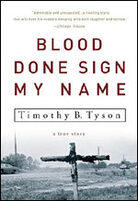
Congratulations to Tim Tyson, whose gripping memoir/history book Blood Done Signed My Name, has found its way onto the big screen. This New York Times story covers this particular tale of book to film, and discusses the way both author and filmmakers sought to avoid the comforting but tired narratives of civil rights victory where whites somehow manage to play the leading role.

Dr. Tyson, who was 11 in 1970, chronicles the struggles that his father, Vernon, a Methodist minister, faced in advocating civil rights progress to a conservative parish. (Vernon Tyson was effectively driven out of Oxford by the end of 1970.) Mr. Stuart’s father was a Presbyterian minister who faced similar trials in Gastonia, N.C.
When Mr. Steel and Mr. Stuart met with Dr. Tyson to discuss turning “Blood Done Sign My Name” into a movie, with Mr. Stuart as writer and director, the author was initially leery of turning over his work to a Hollywood filmmaker bearing the name of a Confederate general. (Mr. Stuart was nicknamed for, but not descended from, the rebel cavalry officer J. E. B. Stuart.) But the men soon discovered they agreed on what the movie should avoid.
“One of the goals was not to make ‘To Kill a Mockingbird,’ ” Mr. Stuart said in an interview at Mr. Steel’s Greenwich office. “What always happens in the way Hollywood tells these stories is that the white guy saves the day. I did not want to fall into that trap. The Tysons got run out of town. Tim’s dad is one of my heroes in this movie, but he’s not Gregory Peck. He’s not going to make it all right for everybody.”

Besides being a fan of “The Fugitive” Dr. Tyson was happy to learn that he and Mr. Stuart both loathe movies like “Mississippi Burning” and “Ghosts of Mississippi,” in which conflicts between good and bad white people overshadow the actions of blacks. Interviewed by phone from his current home in Durham, where he teaches African-American studies at Duke University, Dr. Tyson said that Hollywood’s distortions have helped reinforce the gauzy mythology of the struggles of the Rev. Dr. Martin Luther Kingand others.

“We have this sugarcoated confection of the civil rights movement in popular memory,” he said. “It’s interracial, it’s nonviolent, and it’s successful. Nobody ever opposed it. In this rendition the civil rights movement is largely a call to America’s conscience that America pretty much answered.” The reality, he said, was more complex.

A trailer for the film is here, and Tim talks about the book here.

 
Copyright @ 2008-2010 History Articles | History Article | Powered by Blogger Theme by Donkrax