Showing posts with label religion in film/television. Show all posts

Sunday, March 21, 2010

New Media and the Reshaping of Religious Practice


Paul Harvey

Following up on its recent report "The New Landscape of the Religion Blogosphere," which features discussion of our little blog here along with many other more prominent ones, the SSRC and Immanent Frame have posted short responses from a variety of folks (including myself and more knowledgeable people in the area such as David Morgan and Stewart Hoover) on the question of how (or whether, or if) new media will reshape religious practice. More precisely:

how are new media—from blogs and social networking sites to mobile technologies and other forms of digital connection—shaping and reshaping the practice of religion?

My response (posted again below) speculated on blogging as an updated form of spiritual journaling, a practice familiar from the medieval world to the Puritans and to the evangelicals of the era of the awakenings (keep in mind that this was prepared for Immanent Frame's "Off the Cuff" series, and I take the series title seriously: these reflections are based on nothing more than vague impressions, written "without fear and without research," as somebody once said of a particular history text that we liked to trash in graduate school):

Blogs are becoming something like a combination of spiritual journals and diaries together with personalized newsletters, allowing for people to publicly express their daily thoughts and spiritual practices, for ministers to reflect on sermons past and present, for church members to discuss what their preacher talked about last Sunday, and for intellectuals to issue prompt analytical verdicts on religion in the news and religious trends as reported in the media. The result, I believe, is a continuation of a familiar theme in American religious history—the democratization of religious expression, the relative flattening of authority, and the basic impulse to internalize religious traditions in a personal way. Social networking may have some of that effect (I’m less familiar with religious social networking sites), but may work at cross-purposes as well. For example, Facebook fan clubs for religious celebrities accentuate, rather than flatten out, authority and promote well-known religious spokespeople, as opposed to the decentralized and anarchic world of blogging. Many bloggers, I have noted, keep a list of exercises (personal, academic, spiritual) and give daily or weekly accounts of how well they’ve kept up their disciplines—much like Sarah Osborn did in her personal writings in the eighteenth century, and countless evangelical believers did in the nineteenth. The difference, of course, is that the blog is there as a form of private confessional that holds one publicly accountable.

The technologies are new, but the impulse to personalize, record, and measure one’s spiritual devotion has gone on a straight line from the Puritans to the present.

But maybe, as usual, I'm just late to the party, having arrived after the cool people have left. That at least is the implication of the post by Elizabeth Drescher, who quotes surveys showing the decline of blogging among the younger set, and among those who tend to predict the future of media consumption. She continues:

For one thing, it seems to mean that if we want to understand how digital media practices are impacting emerging religious practice, looking at the religious blogosphere probably isn’t the first place to start. Demographically speaking, with the important exception of gender, the religious blogosphere as it’s mapped in the SSRC report is largely an articulation of mainline religious and academic institutional establishments. Wonderful as the blogs and blogsites studied may be as gathering places for academic and religious thought leaders with a lingering passion for reasonably extended reflection, their very inclusion means that they have participated in a process of institutionalization that is undermined again and again by the very nature of Web 2.0 practice and culture. Fan though I am of many of these blogs, their very status in the various rankings cited in the report places them at the top of a hierarchy that is relatively meaningless in the shaping of religious practice in America. The report, then, picks up the trail of religious change just at the place where it seems to be going cold.

Where might we pick up the scent? The answer, I think, is small: small clusters and communities centered around more or less exclusive and more or less organized social networks, and small communication forms like Facebook status updates and, especially for younger teen girls and young adults of all genders, Twitter feeds. Attending to these micro-forms is something we learned from Steven Johnson’s influential book Emergence: The Connected Lives of Ants, Brains, Cities, and Software. An emergence, Johnson teaches, is lead by ants, not by queens. Small is where we’ll find the contours of new religious identity, community, and practice.

Also included here is a response from our own Randall Stephens, who as usual finds the most amusing quote and is generally wittier than everybody else.

Saturday, February 13, 2010

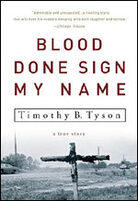
Blood Done Sign My Name -- Out in Film!


Paul Harvey

Congratulations to Tim Tyson, whose gripping memoir/history book Blood Done Signed My Name, has found its way onto the big screen. This New York Times story covers this particular tale of book to film, and discusses the way both author and filmmakers sought to avoid the comforting but tired narratives of civil rights victory where whites somehow manage to play the leading role.

Dr. Tyson, who was 11 in 1970, chronicles the struggles that his father, Vernon, a Methodist minister, faced in advocating civil rights progress to a conservative parish. (Vernon Tyson was effectively driven out of Oxford by the end of 1970.) Mr. Stuart’s father was a Presbyterian minister who faced similar trials in Gastonia, N.C.
When Mr. Steel and Mr. Stuart met with Dr. Tyson to discuss turning “Blood Done Sign My Name” into a movie, with Mr. Stuart as writer and director, the author was initially leery of turning over his work to a Hollywood filmmaker bearing the name of a Confederate general. (Mr. Stuart was nicknamed for, but not descended from, the rebel cavalry officer J. E. B. Stuart.) But the men soon discovered they agreed on what the movie should avoid.
“One of the goals was not to make ‘To Kill a Mockingbird,’ ” Mr. Stuart said in an interview at Mr. Steel’s Greenwich office. “What always happens in the way Hollywood tells these stories is that the white guy saves the day. I did not want to fall into that trap. The Tysons got run out of town. Tim’s dad is one of my heroes in this movie, but he’s not Gregory Peck. He’s not going to make it all right for everybody.”

Besides being a fan of “The Fugitive” Dr. Tyson was happy to learn that he and Mr. Stuart both loathe movies like “Mississippi Burning” and “Ghosts of Mississippi,” in which conflicts between good and bad white people overshadow the actions of blacks. Interviewed by phone from his current home in Durham, where he teaches African-American studies at Duke University, Dr. Tyson said that Hollywood’s distortions have helped reinforce the gauzy mythology of the struggles of the Rev. Dr. Martin Luther Kingand others.

“We have this sugarcoated confection of the civil rights movement in popular memory,” he said. “It’s interracial, it’s nonviolent, and it’s successful. Nobody ever opposed it. In this rendition the civil rights movement is largely a call to America’s conscience that America pretty much answered.” The reality, he said, was more complex.

A trailer for the film is here, and Tim talks about the book here.

 
Copyright @ 2008-2010 History Articles | History Article | Powered by Blogger Theme by Donkrax